Rosselmann
William Tell (P. G. Wodehouse Edition)Rosselmann is a priest and pastor who appears at two turning points in the story: in the immediate aftermath of William Tell’s apple shot, he pointedly reminds Hermann Gessler how close the shot came to killing Walter; later, he brings news that the Emperor has died. His role is less that of a sustained participant than of a witness and messenger whose interventions sharpen the meaning of events already in motion.
Identity and Public Interventions
Rosselmann first speaks after Rudolph der Harras has displayed the apple and praised the shot as a masterful one. With Gessler still sitting on his horse, transfixed and silent, Rosselmann fixes him with a stern look and says, “It was very nearly a 'Master Walter shot,'” The remark redirects attention from the Governor’s admiration of Tell’s skill to the peril he imposed on a child. Its severity lies in the contrast: the shot may be celebrated as a feat of marksmanship, but it was also nearly a fatal one for Walter.
The wording makes Walter’s danger impossible to smooth over as a mere display of skill. Rosselmann’s pointed substitution of the boy’s name for the praise of a “master shot” turns the compliment into a rebuke. He does not challenge Gessler physically or deliver a long accusation; instead, he gives the moment a moral measure in a single sentence. The Governor makes no answer, and the narrative leaves the rebuke hanging in the silence around him.
The Apple-Shot Aftermath
Once the apple has been handed back to Walter, Rosselmann invites him to go to his mother: “Come with me to your mother, my boy,” Walter takes no notice and continues eating. The exchange briefly shifts the scene away from the armed men and the Governor’s authority to the child’s ordinary concern with the apple, which Rudolph had bitten into and returned to him. Rosselmann’s gentle address offers a route back toward family life, but Walter does not follow it.
William Tell, meanwhile, comes to himself with a start, looks for Walter, and begins leading him home, deaf to the surrounding cheers. Rosselmann’s offer and Tell’s action are distinct responses to the same aftermath: the priest calls the boy toward his mother, while the father takes charge of bringing him home. The contrast also keeps the scene’s emotional consequences in view. The crowd celebrates the shot, but Tell has been standing motionless, gazing in the direction the arrow flew, and Walter’s calm gives way only when Rudolph eats the apple. Rosselmann’s brief appeal belongs to this unsettled interval between danger and the return home.
The Emperor’s Death
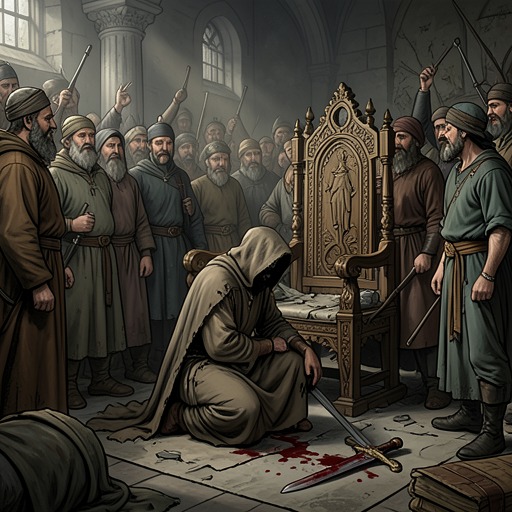
Later, as the crowd is celebrating, Tell notices someone approaching and wonders whether he brings news. The newcomer is Rosselmann, who arrives with what the narrative calls stirring news. He describes the times as strange, prompts the crowd to ask what has happened, and then announces, “The Emperor is dead.” His entrance changes the scene’s scale: the story moves from the local consequences of Gessler’s rule to a death with consequences for the political future of Switzerland.
When the listeners ask how he knows, Rosselmann identifies John Muller of Schaffhausen as his source and vouches for him as a truthful man. He then recounts the reported circumstances: as the Emperor rode from Stein to Baden, the lords of Eschenbach and Tegerfelden, said to be jealous of his power, attacked him with spears. The Emperor had just crossed a stream; his bodyguard remained on the other side and could not reach him. He died instantly. Rosselmann thus supplies both the fact of the death and the chain of reported details by which the crowd can understand how it occurred, while marking the account as news brought to him by another person.
Narrative Role and Consequences
The Emperor’s death allows the revolution in Switzerland to proceed without a check. His successor is occupied with defending himself against the men who killed his father; by the time he can turn his attention to the Swiss, they have become too strong to attack, and Switzerland becomes free. Rosselmann does not bring about this political change, but he announces the event that makes its consequence intelligible. His message turns an unseen death elsewhere into the hinge of the ending.
The two appearances give Rosselmann complementary functions. At the apple shot, his words expose the human cost concealed by admiration for Tell’s skill; in the later gathering, his report connects a distant imperial crisis to the Swiss outcome. In both scenes he speaks into a crowd’s response—first interrupting the triumphal framing of the shot, then commanding attention for news—and his words help the narrative move from immediate danger toward its political resolution. The story’s final account returns William Tell to his home and family, while Rosselmann’s announcement has already explained why the wider struggle can end in Swiss freedom.